
Architecting Authority: How Strategic Positioning Reclaimed a Brand’s Narrative
March 25, 2026
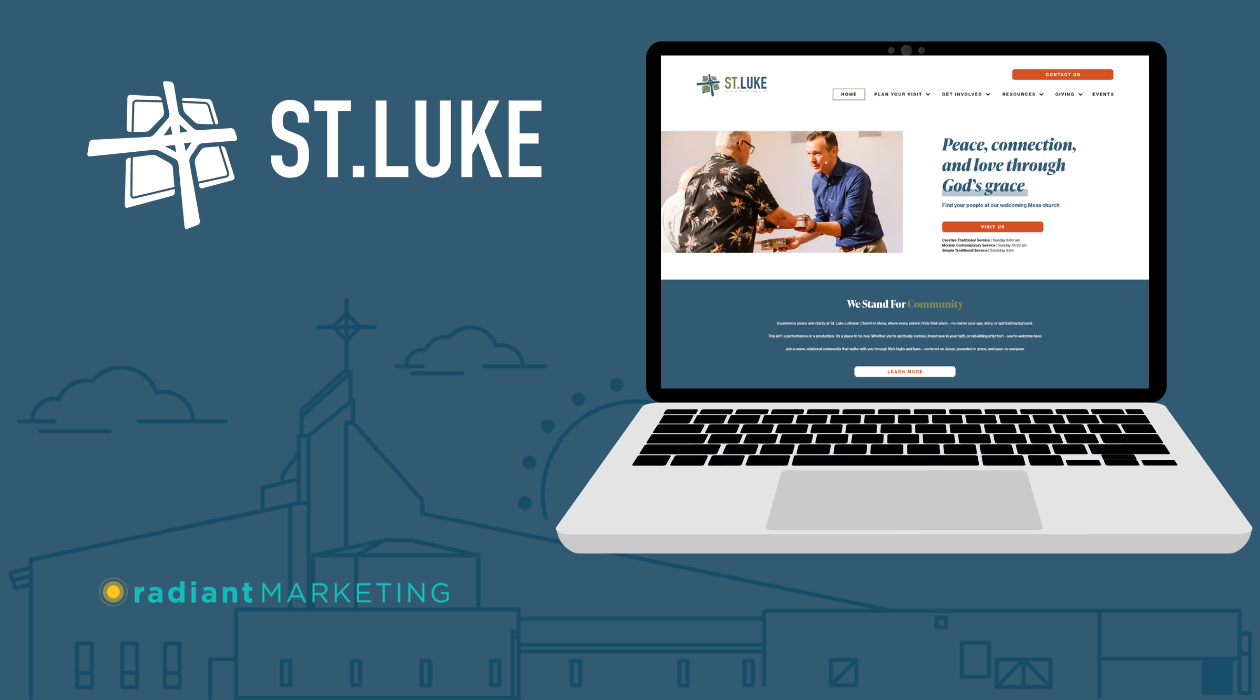
The most enduring partnerships often begin with a high degree of trust.
Our engagement with St. Luke Lutheran Church started with a referral from a former team member (yes we stay connected to many of our past team members!) who recognized a fundamental disconnect: the church was doing world-class work in the community, but their digital “front door” was unintentionally turning people away.
A Referral That Became Something More
During our initial Discovery Session, the St. Luke team described their congregation with refreshing, self-aware candor: “We’re a normal, friendly church doing good work… we’re not a cult.”
It was said with a laugh, but to our team of strategists, it was a vital somatic marker. It pointed to a profound need for a digital presence that signaled safety, authenticity, and authority in a marketplace of religious noise.
They didn’t just need a new platform; they needed an architectural blueprint that communicated their genuine, grace-centered identity to a spiritually curious public.
The Real Challenge
Like many mid-size churches navigating a post-pandemic world, St. Luke faced a challenge familiar to faith communities everywhere: how do you signal to a skeptical, spiritually curious public that you’re the genuine article? That you’re welcoming rather than performative, grace-centered rather than rule-based, and actually rooted in community rather than chasing the mega-church model?
Their digital presence wasn’t answering those questions. When prospective members searched “churches near me” on Google, St. Luke wasn’t surfacing (like, at all…). Their website, hosted on an outdated platform, had grown cluttered over time: dense copy, minimal imagery, and a structure that inadvertently confused the visitors it was meant to welcome.
One example captures it well: a “Watch a Past Service” video placed prominently on the homepage was well-intentioned but created genuine confusion about whether the church was inviting people in-person or simply offering content to consume from a distance. Small detail. Big impact.
Underneath the digital surface was a deeper identity problem. St. Luke had a rich, differentiated brand: a grace-centered Lutheran theology, a “just right” size that fostered real belonging without the anonymity of a large production church, a world-class music ministry, and meaningful community service partnerships. None of that was coming through.
Their positioning was underdeveloped, their emotional value proposition unarticulated, and their communications lacked the consistency to resonate with the people they most wanted to reach: young families, millennials seeking relational faith, people burned by rule-based churches, and individuals searching for community and purpose.
Before the Website, the Brand
We could have skipped ahead and built a pretty website. We didn’t!
Instead, we started with a brand strategy engagement we call “The Heart, Brain & How”: a structured workshop process designed to surface the emotional and strategic core of a brand before translating it into marketing.
Through that process, we helped St. Luke articulate an Emotional Value Proposition: “From overwhelmed and isolated to equipped and connected — finding your people and your purpose to serve in a grace-centered community.” We defined their brand positioning, identified four brand pillars, and developed messaging frameworks built around themes like “Where You Belong,” “A Breath of Fresh Air,” and “Grace for the Journey.”
That brand foundation became the creative north star for every subsequent deliverable. It also gave us (and them!) permission to lean into the “we’re not a cult, we promise” energy in a way that felt genuinely different from most faith-based marketing. Real, warm, and just a little self-aware.
The Build
With the brand foundation in place, we got to work. The scope included a full site build of 20+ pages on WordPress, chosen specifically to give the church full content ownership and independence from developer support after launch.
The previous site had grown to 108 pages (many of which were never visited), so it was sprawling and hard to navigate. The redesign condensed this to 20 focused pages, each with intentional, SEO-optimized content. Fewer pages meant more SEO weight per page and a far more navigable experience for visitors.
We also built the site to serve two distinct user types simultaneously. First-time visitors needed warmth, clarity, and zero friction, including clear answers to first-visit questions. Existing members needed quick access to bulletins, Bible studies, small groups, and events. Navigation was restructured so that anyone arriving at the homepage could find their way in seconds.
One of our favorite details: the custom footer. Rather than a generic color block or typographic treatment, our designer created original artwork using the outline of St. Luke’s own building — transforming a piece of their physical identity into a visual anchor for the entire site. The building that houses the community is rendered as a design element that literally grounds every page. It’s the kind of detail that signals craft.
On the search side, we set up Google Search Console (never previously configured), optimized metadata across all pages, and built out an expanded Google Business Profile, an infrastructure that had simply never been strategically leveraged before.
The Results
181% increase in overall traffic. Active users climbed from 2,100 to 5,900 per quarter. New users went from 1,900 to 5,700 — a nearly 3x increase in people discovering the church for the first time.
Organic search sessions more than doubled. One core branded search query jumped from 98 to 248 clicks: a 2.5x increase. Broader discovery terms like “Lutheran church near me” and “Lutheran church Mesa AZ” saw significant upticks. St. Luke is now surfacing for searches like “ELCA churches near me,” outranking other denominations entirely. Staff confirmed this firsthand from conversations with new guests.
The bounce rate held steady at 33% before and 37% after, a remarkably stable figure given the dramatic scale of traffic growth. The Christmas season provided a real-world test: Night in Bethlehem, a major community outreach event, saw a measurable increase in new guest attendance, with more visitors reporting they found the event online.
As Britney from their staff put it: “We have seen a massive increase in new visitors, and we attribute that almost entirely to our online presence.”
And perhaps most meaningfully: the church now owns its digital presence. Staff can build pages, update content, and respond to their community in real time, without outside help. That’s the outcome that lasts.
A note on this work
We submitted the St. Luke project as an entry in this year’s Spectrum Awards, and reflecting on it reminded us why this kind of work matters. Every decision, from the brand workshop to the platform choice to the tone of the copy, came from genuinely understanding what this community needed. When both sides are truly invested in the outcome, the results go beyond deliverables. They build something that lasts.
Pastor Luke captured the spirit of the engagement well: “You are very personable and take the time to listen to your clients and their needs.” That’s what we’re here for.
Fingers crossed for the Spectrum Awards! We’ll let you know how it turns out! 🤞
Want results like these for your organization? We bring the same strategy-first approach to every client: big or small, product or nonprofit. Schedule a discovery call with Radiant Marketing and let’s start with a conversation.
Join the Radiant list!
Get expert insights, fresh ideas, and our founder’s VIP
notes on brand growth sent straight to your inbox.